GERMANY · BITTENSOR · AI ENGINEERING

Ancient wisdom.
Artificial intelligence.

Aztecai GmbH connects decentralized AI infrastructure with practical AI assistants. From Bittensor operations to Teki, we build around measurable performance and human control. Our next focus: agentic AI security and governance in the EU.

01 / Custom AI Software
02 / Teki · AI Assistants
03 / AI Security & Governance
04 / Bittensor Engineering
Who we are

A Germany-based AI studio
with Mexican roots.

Aztecai GmbH is small, deliberate, and obsessive about quality. The name carries a Mexican founder's admiration for the Aztec engineers — same discipline, new tools.

Germany Mexican founder Bittensor operator & builder
Primer

What is Bittensor?

Bittensor is a decentralized AI network — a protocol where independent operators compete to provide the best machine intelligence, and are paid for it in TAO, the network's native token. Think of it as an open, permissionless marketplace for AI: anyone can plug in compute and models, anyone can consume the output.

01

Specialized subnets

The network is divided into subnets, each a self-contained AI market focused on one task — text generation, image synthesis, quantum simulation, drone autopilots, decentralized inference, and dozens more.

→
02

Miners do the work

Miners are operators who run the actual AI workload for a subnet — serving inference, training models, simulating circuits, generating images. They commit real compute (often GPU fleets) and compete on quality.

→
03

Validators score quality

Validators continuously test miners on benchmark tasks, score the results, and publish a quality ranking on-chain. The better a miner performs, the higher their weight in the subnet's ledger.

→
04

Miners earn subnet rewards

Miners receive subnet alpha rewards according to the network's emission rules and validator-assigned weights. Scoring and allocation vary by subnet; strong benchmark performance alone does not guarantee revenue.

THE ECONOMICS

Real compute, real demand, real value.

Since the dTAO upgrade (Feb 13, 2025), each subnet issues its own alpha token whose price floats against TAO based on supply and demand. Miners receive alpha for their work and can swap it back to TAO on-chain. TAO itself trades on major exchanges — connecting the network's machine-intelligence output to real capital markets. Token prices, demand, competition and infrastructure costs all affect operating outcomes.

Bittensor · Mining & engineering · 2025–2026

From GPU operations to agent engineering.

We operate decentralized AI infrastructure and develop, test and optimize miners across specialized Bittensor subnets. Our work connects model serving, adversarial robustness, computer vision and autonomous agents—with measured quality, latency and operating economics guiding each decision.

Our portfolio preserves the subnets we mined and worked on during 2025 and 2026—even when a project has since closed, changed name or left the network. Historical participation is not a claim of current mining activity. Research-only work is identified separately.

22
Subnets mined · historical portfolio
February 2024
Mining since February 2024

Subnets are counted once across the historical portfolio, including retired projects; research-only tracks and root staking are excluded.

SN64 · CHUTESCORE OPERATIONS

Decentralized AI inference

Operating GPU infrastructure for serverless model serving. Our work centers on reliable capacity, model placement, utilization and the relationship between performance and sustainable operating cost.

Explore Chutes →

SN51 · LIUMCORE OPERATIONS

GPU compute marketplace

Providing GPU capacity and monitoring rental utilization, availability and provider economics. We track rental income separately from subnet rewards to understand the real operating performance.

Explore Lium →
Historical portfolio · 2025

The subnets that built our experience.

Our historical subnet footprint, retained from AztecAI's 2025 company portfolio. We preserve these entries whether or not the original projects still exist. Names shown are historical; subnet IDs can be reassigned to unrelated projects.

SN64 Chutes SN63 Quantum SN124 Swarm SN27 Neural Internet SN49 SN65 SN68 SN69 SN70 SN83 SN85 SN102 SN44 SN47 SN51 SN54 SN75

Where the original record only identified a subnet number, we retain that number rather than substitute today's project name. Root-network staking and validator rewards are not included as mined subnets.

2026 · Mining, engineering & research

Our 2026 portfolio includes mining operations and development across Targon, Perturb, Score Vision, MIID, Leadpoet, REAX, Swarm and Poker44, alongside Chutes and Lium above. Engy and Harnyx are research tracks; Ditto covers agent-memory development and evaluation. These are different stages of work, not a list of currently active miners.

SN4 · Targon ↗
AI compute and inference operations; monitoring miner performance and network rewards.
SN26 · Perturb ↗
Adversarial machine learning: optimizing image perturbations against quality, distortion and latency constraints.
SN44 · Score Vision ↗
Sports computer vision: game-state recognition, detection quality and end-to-end response performance.
SN53 · Engy ↗
Inference feasibility research: serving capacity, latency gates, verification requirements and demand-led economics.
SN54 · Yanez / MIID ↗
Identity-preserving synthetic face variation and evaluation of image quality for identity-testing workloads.
SN67 · Harnyx ↗
Research agents: evidence gathering, answer synthesis and controlled comparisons of quality, cost and latency.
SN71 · Leadpoet ↗
Business research and lead qualification: evidence-backed data, validation and repeatable agent workflows.
SN92 · REAX ↗
Distributed inference engineering: GPU workers, request routing, latency optimization and operational observability.
SN118 · Ditto ↗
Persistent memory for agents: retrieval, memory-harness evaluation and reproducible artifact testing.
SN124 · Swarm ↗
Autonomous-agent research in simulated environments, with policy evaluation and repeatable benchmarks.
SN126 · Poker44 ↗
Exploration of strategic decision-making agents and competitive evaluation under incomplete information.

Our approach: measure before scaling.

Read the actual evaluation code. Establish a reproducible baseline. Compare alternatives on the same tasks. Review security and failure modes. Promote changes only after testing—and monitor the result. We separate benchmark scores from real-world performance, and network rewards from revenue, cost and cash flow.

From infrastructure to everyday work

AI that helps people.
Not just benchmarks.

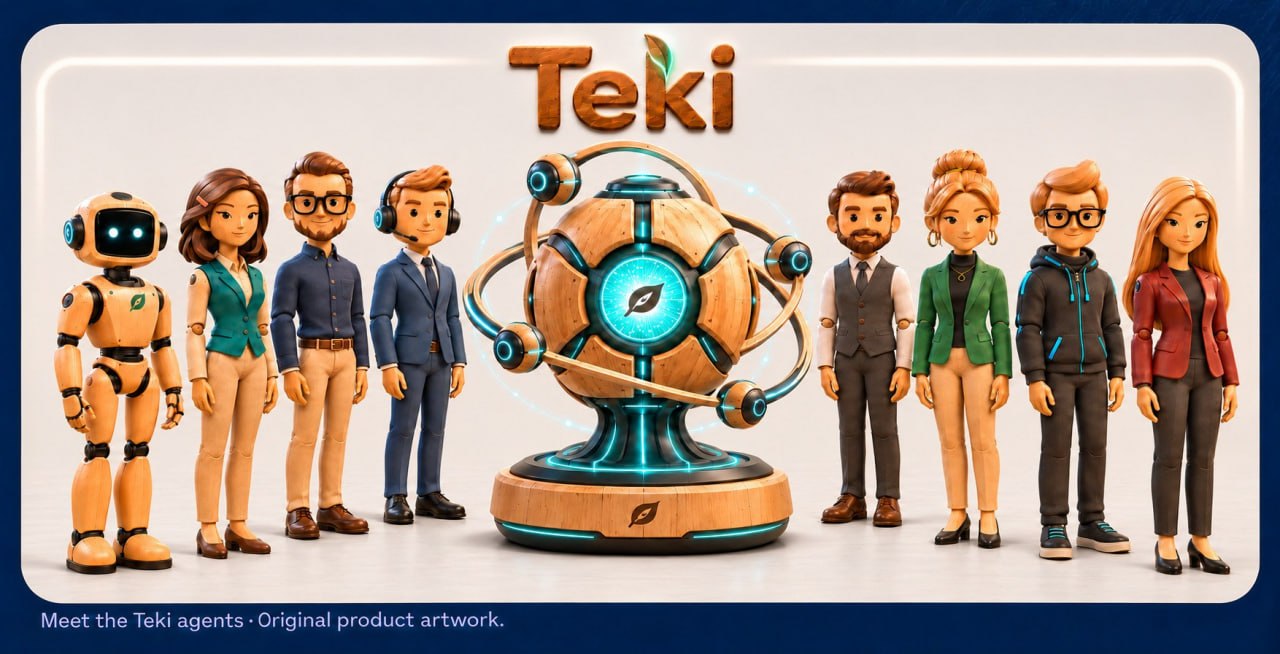
Bittensor pushes us to measure how AI systems perform under real constraints. Teki brings that engineering mindset to a different problem: making a useful assistant part of everyday life and work.

Our direction is practical: assistants with a defined purpose, continuity across conversations and access to selected tools—not unrestricted autonomy. Which capabilities are enabled depends on the assistant, its permissions and the deployment.

Teki agent team surrounding a glowing wooden AI core
Meet the Teki agents · Original product artwork.
Our next chapter · Upcoming focus

Agentic AI Security and Governance in EU

An agent does more than generate text. It can access data, invoke tools and act on behalf of people. Those capabilities need clear boundaries, accountable ownership and evidence that controls work.

Over the coming months, AztecAI will develop this practice for organizations operating in the European Union—bringing our cybersecurity background together with hands-on agent engineering.

Discuss a pilot →

Planned workstreams

Threat modeling & adversarial testing
Identify prompt-injection paths, unsafe tool use, data-exfiltration risks and dependencies across models, agents and external services.
Permissions & human oversight
Design least-privilege access, sandbox boundaries, scoped credentials, approval gates and reliable ways to pause or revoke agent actions.
Governance & evidence
Define system owners, acceptable uses, change controls, evaluation criteria, audit trails and incident-response procedures throughout the agent lifecycle.
EU regulatory readiness
Map intended uses, organizational roles and data flows against applicable EU AI Act and GDPR requirements, with legal and data-protection specialists where needed.

This is a developing engineering and governance practice—not a certification, legal opinion or guarantee of compliance. Obligations depend on the system, its intended use and the organization's role.

Services

Software solutions powered by intelligence

Four core practices. Tailored to your team, your data, and your roadmap.

01 / DEVELOPMENT

Innovative AI Software

Custom AI software tailored to your business — from RAG pipelines to bespoke ML services and inference APIs.

  • → RAG & retrieval systems
  • → Model training pipelines
  • → Inference at scale
02 / AUTOMATION

Custom AI Agents

Tailored AI agents for small businesses and entrepreneurs — built around your daily operations to automate repetitive work and reclaim hours every week.

  • → Workflow automation
  • → Email, docs & CRM agents
  • → Integrations with your tools
03 / QUALITY

Quality Assurance

Robust, observable, production-grade AI. We build evals, monitoring, and guardrails into every system from day one.

  • → Automated evals
  • → Observability & tracing
  • → Safety guardrails
04 / NETWORK

Bittensor Network

Active contributors to the Bittensor ecosystem — designing, validating, and running subnets that push decentralized intelligence forward.

  • → Subnet design & validation
  • → Miner infrastructure
  • → Incentive mechanisms
The stack

Modern tools. Production-ready.

PyTorch Hugging Face Bittensor LangChain vLLM Next.js FastAPI Docker Kubernetes AWS · GCP Postgres + pgvector Anthropic Claude PyTorch Hugging Face Bittensor LangChain vLLM Next.js FastAPI Docker Kubernetes AWS · GCP Postgres + pgvector Anthropic Claude
Jaime Peña, Founder of Aztecai GmbH
FOUNDER & ENGINEER
Jaime Peña
Meet the founder

From automotive cybersecurity to secure AI.

Jaime spent close to a decade building cybersecurity into safety-critical automotive systems — Project Security & Privacy Manager at Continental, cybersecurity consultant on ZF Friedrichshafen powertrain and Continental BCM/Infotainment programs. He is certified in applying ISO/SAE 21434 and UNECE WP.29/R155 to safety-critical products — and that discipline now shapes how AztecAI builds AI.

AztecAI connects three areas: decentralized AI engineering through Bittensor, practical assistants through Teki, and a developing agentic AI security and EU governance practice. Experience operating and testing real systems informs how we approach permissions, evidence and human oversight.

He combines technical depth with direct business communication — earlier sales engineering with National Instruments and Schneider Electric, sharpened by an MBA from Warwick Business School. He works directly with every client. No middle layers, no junior handoffs.

EXPERTISE
▸ Enterprise AI agents — secure, governed agentic systems for production workflows
▸ Bittensor operations — GPU operations, inference optimization and agent evaluation
▸ Automotive cybersecurity — 8 yrs across Continental, ZF Friedrichshafen, Da Vinci
▸ ISO/SAE 21434 & UNECE WP.29/R155 — security for safety-critical products
▸ Threat Analysis & Risk Assessment (TARA) — secure software lifecycle, architecture, code review
▸ Domain experience — Powertrain, BCM, Infotainment, ADAS, AUTOSAR, embedded Linux
CERTIFICATIONS
CISSP — ISC2 CISM — ISACA PMP CEH CySA+ Security+ CompTIA Security Analytics TÜV SÜD ISO/SAE 21434 L1 & L2 Certified ChatGPT Expert German B2
EDUCATION
MBA — Warwick Business School · Awarded with Merit
2020 – 2022
M.Sc. Electrical Engineering — Darmstadt University of Applied Sciences
2016 – 2018
B.Sc. Electronic & Computer Science — Tecnológico de Monterrey · Robotics & Automation · Honorific Mention
2006 – 2011
15+
years engineering experience
10+
security & PM certifications
EU + LATAM
cross-cultural perspective
Let's build

Have an AI project
worth building right?

Tell us about it. We respond within 48 hours with a clear assessment — feasibility, scope, and what it would take to ship.